
Like everyone else, I traveled with a camera. Mine was a little silver point-and-shoot with a mechanical zoom, recommended by the Chassidim at B&H Photo & Video. These are snaps I took in India and Nepal in 1997 and 1998.
Not everything makes the cut. This is a passage from an earlier draft of If Travel Is Searching that includes a whole bunch of detail, including my first visit to an Indian-style toilet. Want to know how that went? Become a paid subscriber!
It was in these last days in Bombay that I found myself starting to like the place, against my better judgment, or against my initial judgment anyway. Part of that must have been the passing of the jet lag. I finally slept through the night. Part of that was just the human tendency to adjust to anything. In Mumbai I had a sense of where things were, a sense of routine, though I had only been here a week. I could’ve started from there to explore the city more deeply if I’d given myself the time. But there were other places to go. I wanted to travel, not to settle in one place, and it was only now that I bumped up against an obvious reality of traveling, which is leaving behind place after place that you’ve only just gotten to know. And up ahead? The unknown, which is always scary in a different way from more of the known, however tedious or frustrating.
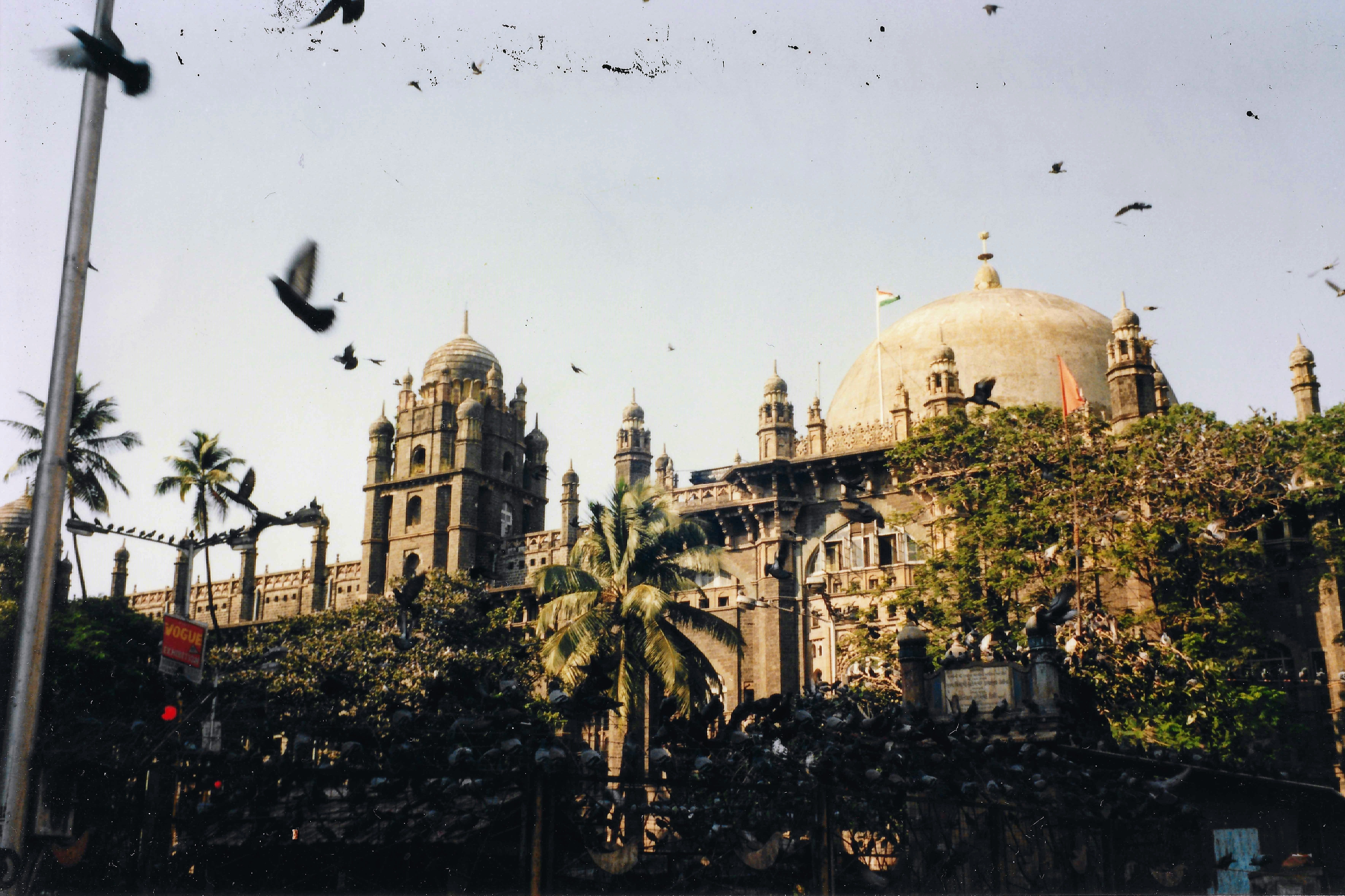
The next day I toured what was then the Prince of Wales Museum and is now the Chhatrapati Shivaji Maharaj Vastu Sangrahalaya, a fusty Edwardian pile with a great Saracenic dome on top and pigeons in swarms. It felt derelict, dingy, forlorn, almost preternaturally empty and silent in the middle of Bombay’s ceaseless bustle and press. The Western paintings were awful, a bunch of dim old portraits of once-important men, but they had a fantastic collection of Mughal miniature paintings and an impressive array of Japanese art for some reason, which made me wish I had Astrid, my Japanese-majoring girlfriend, there to share it with.
I ate a lunch of mutton biryani, good but too spicy for me, and my first Citra lemon-lime soda, all the while watching the businessmen in short-sleeved button-down shirts and shiny pants shovel their curries into their mouths with their fingers, never getting so much as a drop of it on their neckties. It was a kind of magic, what they were doing: balling up the rice with thumb and three fingers, the pinky left out of it, and using this ball somehow to turn what seemed like a liquid into enough of a solid to go from metal plate to mustache-topped mouth in a single quick gesture that sent not a grain of rice or a drop of curry flying anywhere, then tearing off a piece of chapati with a finicky, flickering movement of just the right hand and using it to sop up the sauce. Everyone just knew how to do this, the way I knew how to press the tines of a fork into a piece of meat to keep it steady for slicing. Their mothers had taught them. I ate with a spoon. There would be times, later, when I didn’t get one, and I began to see the wisdom of that guy in the back of that Frans Hals painting at the Met, The Merrymakers of Shrovetide, who has a wooden spoon tucked into his hat. You never know.
I followed lunch with my first use of an Indian-style toilet.
I paid an old woman 50 paise and received an actual ticket, though there was no one else to take the ticket, and went in. It was a squat toilet, the kind with porcelain footpads on either side of a hole in the floor, and I teetered my way through the procedure, worried the whole time that I was going to shit on my pants. Then came the wiping, done by hand. No paper. It was bad, but not as bad as I thought it would be. There was a faucet and a plastic cup, which you could fill and refill for as many pours as it took to get your hand clean, or clean enough anyway. Outside were proper sinks stocked with the ubiquitous Dettol disinfectant soap you saw everywhere.
The rest of the afternoon I spent just wandering the streets. I took in the ominous pool of stagnant water at Flora Fountain, then cut across Horniman Circle, a pleasant enough park full of the lunching, reading, napping employees of the surrounding banks and small businesses. Turning north again, toward the General Post Office, I found myself in narrow streets packed with hawkers and stalls and crowds. There was an energy here, a surging life force that felt good, different from the hard desperate bite of the tourist trade in Colaba. I had judged all of India based on a few forays into the stupidest tourist district in its largest city. Down there it was an awful chaos, but an unnatural one, built around the distorting presence of foreigners with too much money and too little sense or experience. It was in Colaba that I saw naked babies in the street, and the blind man walking up and down the stalls bleating “Naa-naa! Naa-naa!” like a goat, and the beggar bent parallel to the ground, his legs seeming to dangle even as he walked on them. It was in Colaba that I heard the dry croak of the women sitting on the ground, palms up for change. But here, away from Colaba, was something resembling the India I’d come to see. It was like getting out of Times Square and into lower Midtown with all the weird shops selling buttons and fabric. Here the colors were bright, vivid, intense: mountains of tikka powder red orange purple turquoise green, Diwali cards red and gold, carts of bright-colored snacks of all sorts, sweet and savory, and the smell of spices and burnt ghee and human bodies packed close together. And here nobody bothered me. I wasn’t going to buy a cup of water or a shave, so the people selling them had no reason to engage me. I was as invisible and irrelevant here as I was glaring twenty minutes to the south. The only person who took an interest in me was the companion of a bearded, skull-capped man who noticed me pointing my camera at them. He waved me off with a scowl, so I put my camera away.
As I wandered I saw buildings covered in bamboo scaffolding and thin men hanging high up on them. Kids flying kites, playing cricket in the street, idly spinning a scooter tire to amuse themselves. There were surprises, like the sudden appearance of dozens of men sitting at tables, each with a typewriter in front of him, all under cloth and canvas awnings. This was outside some government building or other, and I assumed they were a kind of informal lubricant between an illiterate populace and a voracious bureaucracy. It was just one way that you could sense how poor Bombay was. Somewhere there was money, that I knew, but most things seemed run down, grimy, patched together, and everything done by hand, from shop signs to paperwork. Here manufactured goods and materials had a cost, but labor was nearly free. There was starker poverty too: men getting shaved in the street, taking full-body sponge baths, living out on the pavement what ought to have been private moments. It wasn’t like the begging and grasping in Colaba though, and it wasn’t like the poverty you’d see in New York City either, where the homeless were furtive, defeated and apologetic, sharing in a general understanding that if you were that poor there must be something wrong with you. Here in Bombay poverty seemed normal, or normalized at least. It was so common that you couldn’t interpret it as a statement about anything.
I was heading to the GPO to mail a letter to Astrid, but first I went up to Victoria Terminus, Bombay’s vast central railway station. I had no train to catch, but I was curious. Like most of the monumental British buildings in town, the station seemed to glower, a great Gothic beast of a thing. Inside were the rumbling Indian trains, dried-blood red with yellow numbers on them, hand-painted of course, and crowds of people: bearers with carts or carrying great piles of sacks on their heads, families in traditional dress, businessmen, children, people sitting in dim corners who were there to beg or to rest out of the sun for a while. I took it all in, glad I wasn’t going to be on any Indian trains anytime soon, then turned and headed for the post office, which was yet another grandiose British building under yet another grandiose British dome. The women working there resembled the beggar women in the streets: same nose rings, similar facial features, same style of sari. I wondered if this was a sign of caste, something I had no real sense of, and if these were Dalits, scheduled castes, what used to be called Untouchables, in their set-aside government jobs. Crowds seemed to swarm at every counter, and it took me a while to figure out that I needed to go to Enquiries to have my letter weighed. No one queued. Watching what everyone else did, I pushed myself forward through the crowd — I had some experience with this sort of thing, but usually to get a few feet closer to the Red Hot Chili Peppers or Primus or someone — and shoved my letter through the grating next to all the others. The woman who grabbed my letter told me the price in Hindi, then in English: “One seven.”
On the way back to Colaba, feeling the heat, I pointed myself toward a sign for Bisleri mineral water, but when I came to the little restaurant, I saw they had mango Frooti, the drink I’d seen in the ad at the movie theater. I tried one, and it wasn’t half bad. Syrupy, but a nice change from soda and bottled water.
Passing under an arcade across from Horniman Circle, I caught sight of some posters of Ganesh that pulled me in like a magnet. Most of the depictions of gods I’d seen hewed to a particular style that was naturalistic in depiction but cartoonish in its vivid coloring and with a kind of glamorous smoothing. It was a style you saw everywhere, and as far as I can discover, it goes back to a turn-of-the-century Keralan painter by the name of Raja Ravi Varma, who was given his “Raja” title by no less a figure than Lord Curzon, the governor-general of India. Varma exhibited in Vienna and at the same 1893 Chicago World’s Fair where Swami Vivekananda overawed the American audience at the Parliament of Religions, launching the first Vedanta missions to teach Vedic Hinduism in the West and spurring an enduring interest that would reach its tendrils up through history and push a certain California-born Jew out into the world. Varma’s so-called mythological paintings were widely reproduced in lithograph, giving him an unprecedented reach, and his approach seemed to have settled into a standard, so that the images you would see everywhere of Saraswati, Shiva, Krishna, Kali all had this particular look, a little garish and a little creepy: gods of the uncanny valley.
These Ganeshes were nothing like that. Done in red, black, beige and gold printed in sparking relief, they were modern, stylized, with hints of cubism’s fractured forms. Each of the four different Ganeshes held me with his fierce gaze. I wanted to buy one. I spent a long time admiring them, and the man selling them finally convinced me just to take all four. I did, including the one with a vivid red swastika on his upturned, benedictory palm, feeling a little frisson of the forbidden as I imagined such a thing in my future home. I would grow used to swastikas in time, but at this early point they startled me whenever I saw them, which was often.
Ganesh is popularly known as the remover of obstacles, but properly speaking, he’s Vighneshvara, Lord of Obstacles, there to clear them but also to place them, as the situation requires. Sometimes the direct route isn’t the best way to get where you’re going. In the coming weeks and months, it would often be the detours that took me to the moments and experiences that mattered most. Bombay itself had become a kind of obstacle, both holding me in place — I’d blown a full week now and gotten no further than the post office — and driving me out of India to Nepal. But I would be back.
I hauled those posters around a long time in my backpack, rolled into a tube, and I did hang them for a while in various apartments, where they always creeped out whoever I was living with. They’re intense, fierce, dangerous. They follow you. They need a space larger than a New York apartment. I still have them. When I lived on my own with too many rooms in Korea I put them up again. But my wife has no desire to see them, so they sit in storage now.