Here’s an excerpt from my memoir, If Travel is Searching, that I’m working into a standalone essay. I’m looking to publish that soon. But in the meantime, I wanted to share this line of argument—one that links the Western fantasy of India as a land of ancient wisdom with the long history of Western anti-Semitism—at a time that I think calls for it.
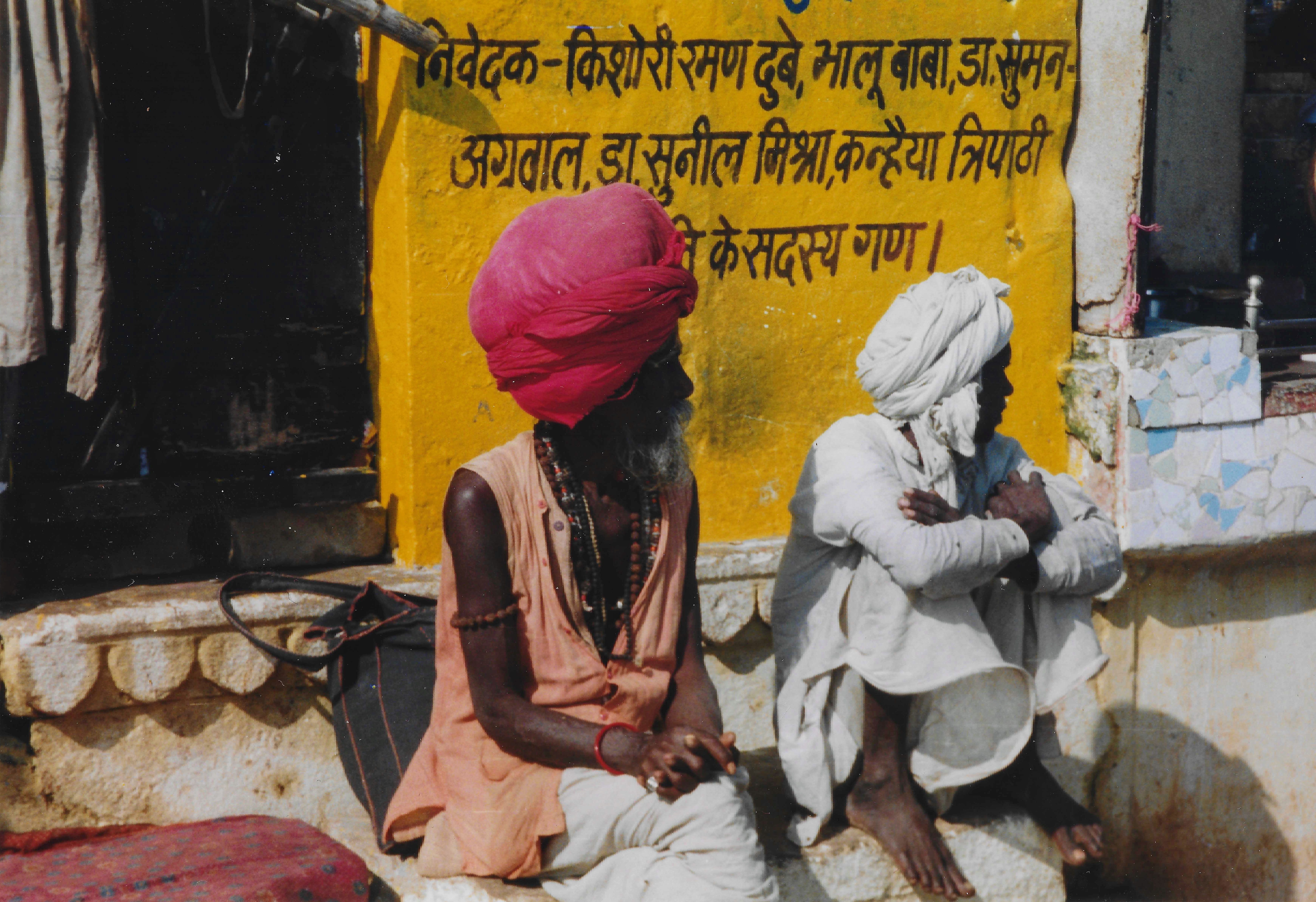
Varanasi—Benares, Banaras, Kashi, the city of light!
By its own mythos, Varanasi is the center of India, which is the center of the world, and it’s the birthplace of the universe, the abode of Shiva but also connected to Vishnu and Brahma. It existed before time. Taking the historical view, Varanasi could seem almost as old, with traces of a city—a holy city—going back thousands of years at this particular bend in the Ganges, at its confluence with the Varuna. The original holy city was a little to the north, and there it stood for some millennia, while the area to the south, where the city is today, was known as the Forest of Bliss, dotted with lakes and temples. The Buddha is said to have visited.
Varanasi went about its sacred business for centuries. Then the Mughals came. Emperor Akbar sacked the city in 1567, destroying much of it and building mosques on Hindu sacred sites. (Or else he didn’t. Depends who you ask.) Whatever the extent of the destruction, something happened, and the city rose anew its present location, on the old Forest of Bliss. With all the changes, you could argue that the Varanasi I visited wasn’t the ancient city of the Puranas. Yet I felt a continuity to it all, a sense that Varanasi had grown and changed but always been here, never ceasing. You heard Sanskrit chanted in the streets. People had been living here, and auspiciously dying here—a death in Varanasi, it’s said, will liberate you from any further rebirths—since the beginning of history. Other ancient cities had faded and disappeared, or they’d been changed by the imposition of new faiths, but Varanasi had endured as the sacred center of Hinduism.
It made me jealous.
This is what it might have been like, I kept thinking, if we hadn’t lost our holy city. The rituals and faith would be changed from what they’d been millennia ago, of course, but the sense of continuity—of doing now a direct continuation of what your ancestors had done—that was what the Hindus had and we Jews didn’t.
When I had this thought, I didn’t realize that I was joining in a tradition, very old in Western thought, that painted Judaism as fractured, broken, inauthentic, and that held out India as its antithesis, a society that had maintained its integrity since the dawn of time. There’s a reason the guy who did the Holocaust also painted swastikas on everything. India as a kind of anti-Israel had a pedigree.
To make sense of this, you have to go back a bit in Western thought to a time when everyone agreed that the world was roughly six thousand years old, that it had been created by a God who gave people literacy as part of the starter pack, and that its history was one of continuous spiritual decline from Eden. The best available record of all this was the Old Testament. But for Christian Europeans, this posed a problem, because the Old Testament was written and passed down by the Jews, and the Jews couldn’t be trusted—after all, they’d turned on one of their own and refused the message of Christ. And so, as Europeans came into contact with the civilizations of Asia and North Africa in the sixteenth and seventeenth centuries, they hunted for any text that might predate Moses, some relic of the original monotheism that must have been practiced by Adam and Enoch and Noah. For a while the focus was China, but eventually it turned to India, where rumor had it that the Brahmins were still passing down some very, very ancient texts called Vedas. Were these the missing link?
This was mostly the province of Jesuits until Voltaire got a hold of it. Voltaire was a Deist, which meant he believed in a unitary creator God, and he was an anticlericalist, which meant he thought the Catholic Church was full of shit and unnecessary. He was also not very fond of Jews, at least in the abstract; it’s not clear that he knew any. So when Voltaire got hold of a document called the Ezour Vedam sometime in the 1760s, he ran with it. What he had was written in French, but it was supposed to be a translation of an extremely old Sanskrit text, a dialogue between a defender of a primal monotheism and a Hindu believer in multiple gods. Guess who wins? If this was all rather convenient, there were reasons. The Ezour Vedam had been written in French by Jesuits in South India who’d intended to translate it into Sanskrit as a tool for proselytizing, though they never did get around to it. Voltaire probably knew this pretty early, but he was never one to let facts get in the way of a useful argument. His championing of Indic wisdom touched off a European mania for all things Indian. Actual translations of actual Sanskrit texts started reaching Europe soon after, and all this created a sense—one that still lingers on in Western thought—that India was the keeper of the world’s oldest and deepest wisdom.
It was also around this time, you’ll recall, that the link was made between Sanskrit and Latin, and later with other European languages. German seemed especially close. And this raised a question: If Sanskrit and European languages had common origins, where did they come from? The answer scholars came up with was that there must have been a primal race—they were called Aryan, after an old name for India—and they must have been great warriors and conquerors, because their languages were spoken so widely. This turns out not to have been especially true, but never mind. It was what stuck, and for a long time Europeans fought over where these Aryans had started out. India? The Pontic Steppe? The Caucasus? Scandinavia? Germany?
The Germans in particular got attached to the idea that they were the Aryans. They’d been frustrated when French and not German replaced Latin as the language of European scholarship, humiliated by the French during the Napoleonic Wars, and humiliated again in the Franco-Prussian War. As a kind of consolation, some of them embraced the idea that they, not the Latins, were the true originators of all that was good and strong and vital in European culture. The Teutons weren’t losers after all. They were the master race. They would revitalize Europe with their superior bloodline, and they would sweep aside the scheming, materialistic, unspiritual Jews and their neverending plot for world domination.
We know how that story played out.
What’s less well understood is the way that this idea of India as an alternative to the Judeo-Christian—emphasis on the Judeo—made its way into what we think of as the progressive, openminded side of Western thought. Madame Blavatsky, for one, believed that “there must … be one truth which finds expression in all the various religions — except in the Jewish,” a religion she described as one “of hate and malice towards everyone and everything outside itself.” Among Blavatsky’s followers were a whole range of intellectuals and influential minds, everyone from Thomas Edison and William James to Rudolf Steiner and Maria Montessori to Arthur Conan Doyle. It was a milieu where casual antisemitism was just part of the atmosphere, and in particular this idea that the Jewish tradition was something corrupted, broken, fallen — that its claims to continuity were false, and that it was now a degenerate thing. You can see this still in the ways people talk about the Jewish connection to Israel, insisting that there isn’t one.
You can also see this in the growing Western interest in Hinduism in the 1960s. In a book of essays called Vedanta for Common Man, from 1962—edited by Christopher Isherwood, and with contributions from Aldous Huxley, Swami Vivekananda, and Jawarhalal Nehru, among others—you can find this curious passage from Gerald Heard:
We may say that the appearance of Vedanta in the West as a living religion, and not as an academic study, is inevitable just because the religious heredity of the West has now outgrown the tight Hebrew pot of cosmology in which it had been growing for two millennia. A faith that taught hell for those who did not get themselves saved in this life was suited enough to put the fear of God into barbarians or into men too busy to do much more than make a dash with their last breath for a deathbed repentance. But for people really interested in the spiritual world, really desirous of growing in spirituality and filled with a real longing to know and love God, such doctrines were, far from being any help, a terrible obstacle.
Never mind that hell is a Christian doctrine, not a Jewish one. Hebrew cosmology is here cast as a constraint on the development of the West and a terrible obstacle to anyone interested in true spirituality. That something like this could be delivered, without irony, less than two decades after the literal attempt to annihilate the Hebrews and replace them with Aryans, is a sign of how deeply this idea had made its way into Western thought, not only on the fascist right, but on the progressive left. As Blavatsky had it, “all the various religions—except the Jewish.”
I was no more immune to this thinking than anyone else. I once described Judaism to a girlfriend as something you couldn’t ever get rid of, “like syphilis.” My push-pull intellectual struggles with Judaism were so obvious that my Honors English teacher senior year told me I should read Spinoza, a suggestion I’m still not sure wasn’t anti-Semitic.
And so I was in Varanasi, and not Jerusalem, and I carried with me many of the same ideas as every other Westerner, about the Hindus and the Hebrews both.