
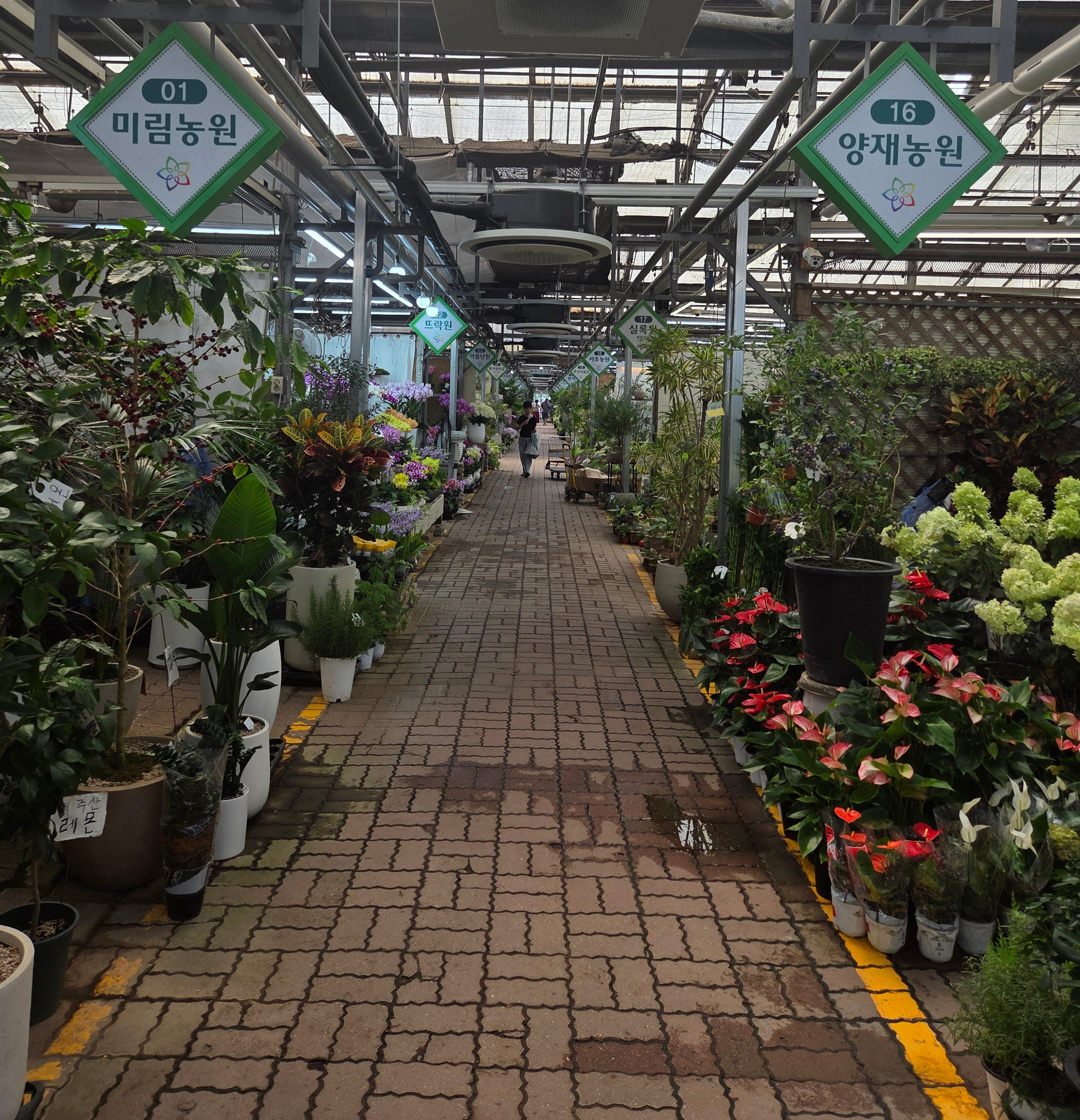
Today I visited Yangjae Flower Market, on the southern edge of Seoul. It includes both a huge cut-flower market that on a Friday morning was full of middle-aged women, and a sprawling plant market that had few people wandering the greenhouses on this scorching day.
I was on a mission.
The main character of my novel in progress has a passion for terrariums. He likes making them, and eventually he turns an entire room of his hanok—traditional Korean house—into a giant terrarium. He first makes one in a vaguely magical shop near Dongdaemun.
To tell the story well, I realized that I need to learn what it feels like to make one. And it was anything but magical.
First an elderly husband and wife argued about which of them was supposed to talk to me, and I ping-ponged between them for a while. Then I was told to wait, so I waited. All of this in Korean, of course. At last I was shown to a table and conducted through the process of assembling my first proper terrarium, in a glass bowl: pebbles, then a layer of black, sticky soil that could be molded up the sides to give some shape, then a selection of rocks for style and texture, then mosses, then ferns.
Throughout this process, as I fumbled with the long tweezers, the old woman kept up a running commentary, some small parts of which I understood. The gist was there, anyway: I was doing it wrong. I should not have put in all of the moss at once, but done it around the ferns as they went in. I should not have scattered those little accent pebbles in that area over there. Here, this tiny frond of moss is upside-down, and you can tell because the root is over here, utterly identical to the stem I’d shoved in the soil. Now spray it with water. Now take this baster and remove the water—no, not on the table! On the floor!
I was fairly sure she thought I was the dumbest person she’d ever met, until the very end, when she encouraged me to come back again soon.
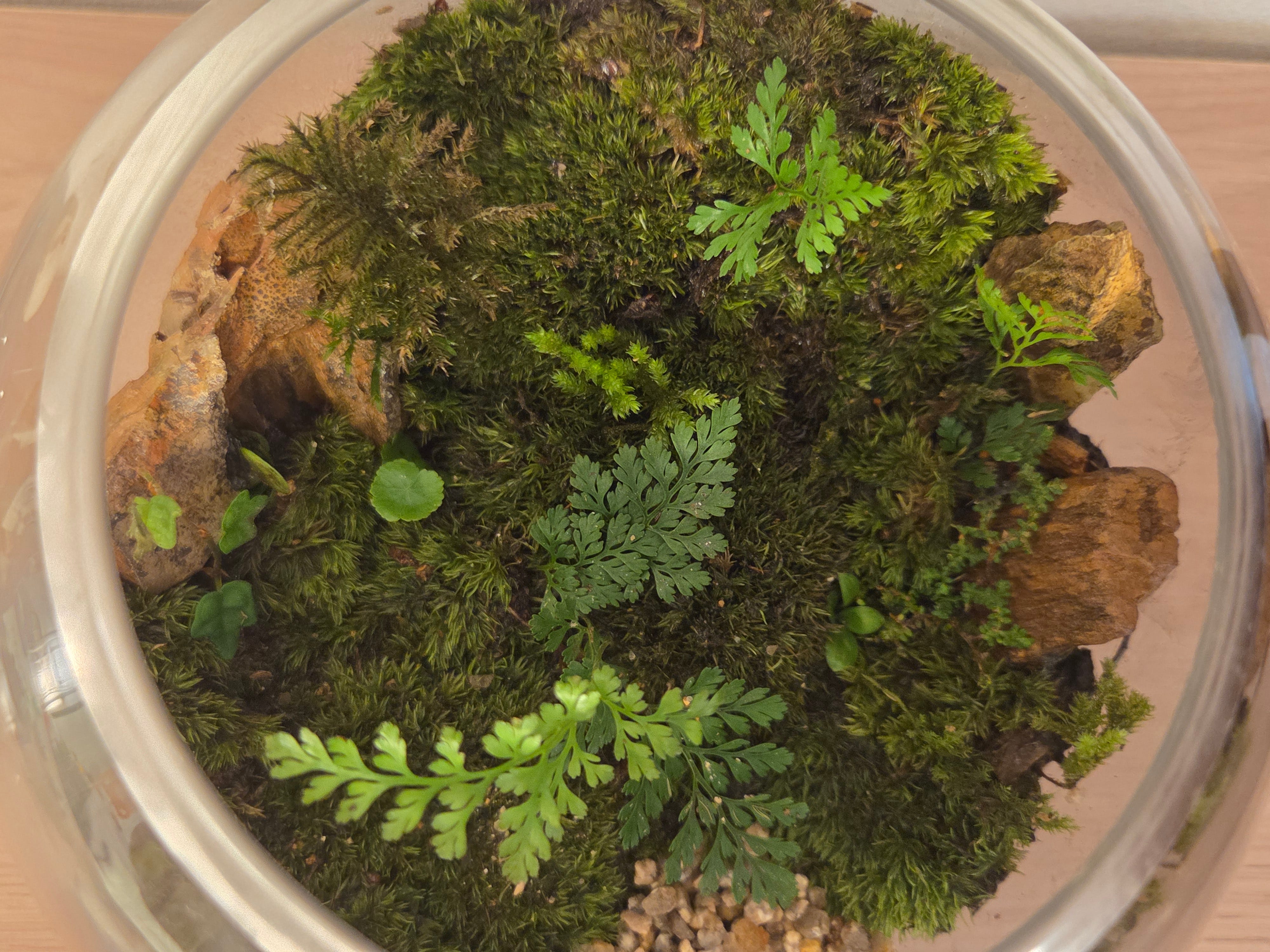
The end result is actually pretty cool. I like it. I hesitate to say I made it—the woman did an awful lot of fixing up my fumblings with the moss, replanting the ferns she’d picked out, telling me where to put things—but I suppose we made it, and that’s something.
The whole experience helped me to shape the arc of my novel. I realized that my main character already lives in a house with a glass roof over the living room, so it would be natural for him to fill it with some of the many beautiful large plants I saw: a ficus grove, a cactus corner (he can get really into it and play Calexico for a week), a coffee tree. And he can come back again and again for terrarium lessons from the lady I met. And all of this together can give him the expertise he needs, little by little, in both terrariums and care for larger plants, that would lead him to build a whole room into a terrarium.
And perhaps more important than all that, my daughter’s interested. When I asked if she wanted to make a terrarium with me sometime, she said, “No” and wandered off. She’s eleven, so that’s the standard answer. But she thinks it’s cool. I ordered a kit and will make another, at home, with no one to tell me I’m doing it wrong. Except maybe my daughter. She can tell me I’m doing it wrong.
I hope she does.