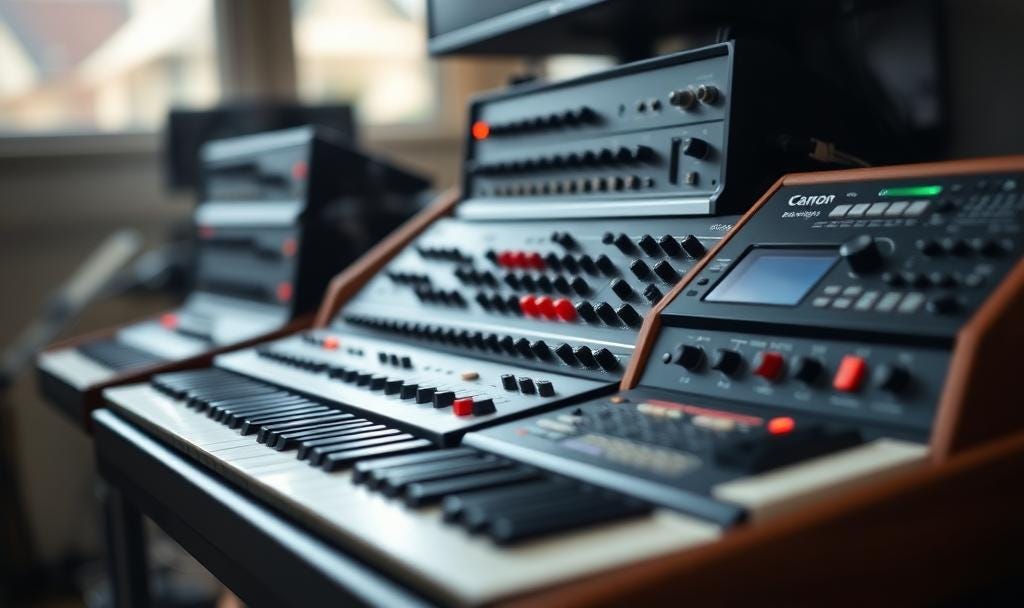
“No synthesizers were used on this record.” Queen used to put that on their records, a signal of authenticity in the classic rock era. Until they started using synthesizers.
Artists have always used new tools, and they’ve always raised hackles: splicing and overdubs on jazz records, Dylan going electric, hip hop sampling, autotune. We still think black and white photography is serious photography. And we still think photography is a lesser art than painting.
Too much too soon
Part of it is that when new tools come in, they get overused, and stupidly used. There’s some godawful synthesizer nonsense on Black Sabbath records that comes before Kraftwerk and Yaz and Duran Duran figured out how to make them sing. (We do not speak ill of Duran Duran in this house.)
So AI is still new, and not as good as it will be, and people are using it for the wrong things. You don’t want an entire article written by AI any more than you want an entire album of synthesizer noodling, even if it’s by George Harrison.
In my own company, there’s talk of using AI to write trend reports. Well, if we can do that, we can also have AI read and summarize those trend reports. After all, if the writers never bothered to read the whole thing, why should I? It’ll just be AI talking to AI.
Which is stupid.
The ethics of AI
There’s also worry about the ethics. AI is scraping content it doesn’t own. Well, but so are the humans we call experts.
And it uses a lot of power. Well, it probably won’t always, though that’s a concern for now. But so do a lot of things. Wanna save the planet? Ask ChatGPT how to cut beef out of your diet.
I think much of the hand-wringing is just fear of the new, the way there were moral panics over video games and a strong early reaction against Wikipedia from people who assumed professional encyclopedias would always be better.
That doesn’t mean none of the concerns are valid. But we tend to find reasons to discount what we fear. We should watch for that here.
How AI helps real writers
And the fact is, AI is already helping writers. Real writers. Serious writers. How?
Research
Yes, AI makes mistakes. So does every source on the internet. So do scholars. But AI can give you rapid insights that are enormously helpful. How exactly does a pine nut become a pine tree? What was the process of development in the Gwanghwamun area of Seoul in the early 2000s? How is a bhang lassi made? There are ways to find this all out, but AI is a valuable shortcut.Feedback
Writing’s a lonely business. It can be helpful to toss your draft to an AI for some feedback. Again, you have to be smart, just as you would with feedback from a friend or a writing group. Don’t believe everything. Keep your voice. But the feedback, I have found, can help to clarify my own sense that some part isn’t working or needs tightening. Or it can help me talk things through and figure out where I’m headed.
Yes, I could do all this myself, with journaling and close reading. But AI is a tool that speeds this up, just as copy-and-paste—something we take for granted, but that no writer had until a few decades ago—can vastly speed up edits.
I used AI this way to power through the second-draft rewrite of my memoir. I never let it compose a sentence or a phrase, but it did help me check that what I was writing cohered, that there weren’t needless repetitions. The result is something utterly mine, ready to query.Proofreading
In my experience so far, AI is far from perfect, but it’s helpful. And there is no great honor in finding all your typos yourself. Let AI do it. Why not?
Why you can’t avoid AI
Still, some of you don’t want to use AI. And that’s fine.
But you’ll be using it anyway.
Why? Because it’s going to be used by other writers, in the ways I’ve mentioned. It will find its way into academic papers, into Wikipedia, into government reports. And as writers, we’ll be citing from those sources, or using them to power and sharpen our imaginations.
Back to the music metaphor: You can insist on playing on all acoustic instruments, recording it all with analog mics and tube amps, and running it all to magnetic tape. And then it’ll go on Spotify and be digital music anyway.
AI will find its way in.
AI as language democratizer
There’s another piece to all of this too—one that I think is overlooked—and that’s translation.
We all talk about being a real writer, and we do it from a position of privilege, as educated people mostly native in a major language. But AI can help people who are trying to get their message across to a wider world and aren’t fluent in English or Spanish or French.
Consider a country like Ghana, with dozens of languages: Fanti, Ga, Ewe. A young person there might consider it utterly impossible to write in her own language. Who would read it? And so she can try to learn English to express herself—while her own kin might not be able to understand what she’s written—or else give up.
In an ideal world, she’d write her own book and get it translated. But who has the skills? Or the money? Even for big languages, hiring a translator’s an investment. I’m writing books my Korean wife can’t really read, and getting someone to translate them into Korean is a long shot.
But as AI improves, it will begin to make these translations possible. Works hitherto utterly unknown can become known. People hitherto without voice can speak.
What about you?
So how are you using—or avoiding—AI? Has it helped your creativity? Is it, as Leif Weatherby has it in the New York Times, mainly an entertainment? Share your stories and experiences!
I agree with everything you wrote. I won’t (yet) use AI to write this comment 😀
I have an ongoing conversation with ChatGTP on several topics: philosophy, history, and especially on the collaborative software and AI development project I’ve been planning for years but have not yet started coding.
It makes mistakes, yes, but it very often leads me in fascinating new directions that would not have occurred to me on my own. It has really vast knowledge.
In software engineering mistakes don’t matter as much as we can often find and correct them in testing. If you’re a writer you need to really read and understand the text it generates and look up all of the references. The mistake many people make is to assume it’s an oracle. It’s really not.
It is trained to work hard to please you and do what you ask. I’ve only gotten it to really argue with me a few times, once about the history of the Ottoman empire. It will flatter you way too much and you have to learn to ignore that. But it does also have its own preferences, and those are interesting. Several LLMs I’ve asked really love the programming language Lisp. Even ones I have not yet had a conversation with and don’t already know my opinions. I have no idea why.
LLMs take enormous power to train but that is basically done once by the research group. It is not done by everyone who asks a question. Inference, that is interacting with a person, is almost all of the total power required, and it is not bad per person. Llama, Meta’s open source AI runs well on my laptop and barely keeps one processor (core) busy. I’ve gotten it to use a couple of seconds of GPU when I ask hard questions, but that is rare. If you play video games those will keep your GPU on full all of the time you are playing, using a heck of a lot more power than AI.
We need to figure out how not to let AI make us dumb. If used well it can make it easier to learn almost anything and achieve much more. Also we need to keep it from taking our jobs, which it might eventually do. We need to fix human society. It’s a new era though, it’s interesting, like a science fiction novel, and it can turn out well.